Is Danielle Smith a Separatist?
Her actions speak louder than her words


I’ve been looking back at Brexit through the rearview mirror of Alberta’s runaway referendum train. And I’ve been studying David Cameron, the UK Prime Minister who called for the Brexit referendum in 2013. Ran a reelection campaign on the promise of one. Was handed a majority government in 2015 in part on the basis of that promise. Ran a campaign to remain in the EU in 2016. Lost. And then resigned the next day.
I’ve been thinking about how the story of David Cameron and the Conservative Party differs so starkly from the story of Danielle Smith and the UCP and the looming referendum they have orchestrated in the province of Alberta.
Smith, by contrast with Cameron, has never promised a referendum to decide Alberta’s place in Confederation, nor run an election campaign on that promise. On the contrary, she has always been coy, and calculated with respect to her position on national unity. She says she supports a “sovereign Alberta within a united Canada.”
You don’t need to be a scholar of public international law to know that if Alberta is sovereign, Canada isn’t united. If Canada is united, Alberta, as a sub-national province of Canada, is not sovereign. We’ll leave this detour into basic international law there. Suffice it to say that you can’t have your sovereignty both ways.
My Grandfather, who commanded Canadian warships during the Battle of the Atlantic and on D-Day used to say that “actions speak louder than words.” So what can we learn from Danielle Smith and her UCP’s actions that can provide us insight into their position on Canada?
Looking back to Brexit and the example of David Cameron’s Conservative government helps to illuminate the Premier’s true stripes.
Brexit
The idea for a Brexit referendum was first articulated in the form of a promise. This promise was made by Prime Minister David Cameron in 2013. The promise was that if his government was returned to power in the next general election, they would hold an in/out referendum to determine whether the UK should remain a member of the European Union. The Conservative party wrote this promise into their own party platform in the 2015 election.1 They would negotiate new terms with the EU, and let the people have their say on whether they agreed with those terms by 2017.
The Conservatives ended up winning an unexpected and slim majority government in the spring of 2015. That year they passed the European Referendum Act, which wrote into law David Cameron’s 2013 promise, and set a date for the UK to decide whether they would leave or remain in the European Union.
This was a major piece of legislation that was introduced in May shortly after Cameron was returned to No. 10 Downing Street. The legislation went through a very standard and thorough parliamentary process, with first, second and third readings playing out over a period of months, and culminating in Royal Assent being given on December 17th, 2015. The European Referendum Act came into legal force the following year in February of 2016, and put the now notorious Brexit referendum on the calendar for June 23rd.
At the same time, Cameron’s government renegotiated the UK’s position in the EU. The terms of that renegotiation were put on full display for all in the UK to vote on, just as Cameron and his majority Conservatives had transparently and democratically said they would do if re-elected.
Cameron, for his part, was decidedly not in the Leave camp. He campaigned forcefully for the UK to remain in the European Union and fully anticipated that after all was said and done the Remain side would win. The UK would remain in the EU under improved terms, the Eurosceptics would be appeased, and he would carry on as Prime Minister. But on the morning of June 24th, the UK woke stunned to find out that they had voted to leave the EU.
Cameron resigned the next day.
The UK was mired in years of messy exit negotiations with the EU. It was a total debacle. A botched gambit that sacrificed a decade of economic growth for the UK, weakened the EU, and emboldened Vladimir Putin.
Despite all this, it is noteworthy that the road to Brexit was paved transparently and democratically through both representative and direct democratic processes. (We’ll leave the campaign itself—which was full of dark money, disinformation, foreign interference, dirty tricks and hijynx, aside for the moment.)
Cameron didn’t surprise the electorate with an unwanted Brexit referendum. He was elected to bring it about. He was given the mandate to do what he said he was going to do. He did it. It didn’t turn out as he’d hoped it would (for a lot of reasons that are highly relevant to Alberta’s upcoming experiment with direct democracy). On the contrary, it was a colossal political fail, a face plant of epic proportion. But no one would accuse the former British PM of acting in a way that was antithetical to the mandate the people gave him. His actions lined up with his words.
#ABexit
The United Conservative Party (UCP) was not formed in 2017 as a separatist party, and did not run, and was not elected in 2019 or 2023 on a separatist agenda. The UCP is not the Alberta equivalent of Quebec’s Party Quebecois. They did not make a promise to Albertans to hold a referendum on the province exiting confederation during their campaign. That outcome was not written into their platform. It was not part of the pitch on the doors. There was no advertising to the effect that “a vote for the UCP is a vote for a referendum on Alberta leaving Canada.” None of this was transparently laid out for Albertans to vote on in a general election.
On May 29th, 2023 the UCP won a relatively slim majority over Rachel Notley’s NDP. There was an expectation that the UCP would continue in the Alberta Conservative tradition of taking an antagonistic approach to relations with Ottawa, and the newly formed UCP tradition of governing the province like an oil and gas lobbying firm. But few would have anticipated a steady drumbeat of legislation designed to intentionally bring about a referendum on secession, let alone load the dice in favour of the secessionists.
On April 28th, 2025, Canadians re-elected a Liberal minority government, much to the dismay of Conservatives across the country who had expected to reduce the Reds to a handful of seats before Mark Carney came along.
In the lead up to the campaign, Smith went on Breitbart news to explain the dynamics of the tariff war and the 51st state threat on the forthcoming election. Smith said “I would hope that we could put things on pause, is what I’ve told administration officials: ‘Let’s just put things on pause so we can get through an election. Let’s have the best person at the table make the argument for how they would deal with that’, and I think that’s Pierre Poilievre.”2
This was the line that grabbed attention at the time, because it seemed to suggest that she was conspiring with Trump officials to influence the (then) forthcoming election. As it turned out, Trump unexpectedly took to Carney and turned on Poilievre, and we know the rest.
On April 29th, the UCP went into full reactionary mode and introduced Bill 54 into the provincial legislation. The Bill was designed very intentionally to pave the way to a referendum on secession, one steered by the separatist advocacy group The Alberta Prosperity Project (APP) through their CEO Mitch Sylvestre.
The first way Bill 54 does this is by lowering the thresholds for the petition. Previously, the signatures of 20 per cent of all eligible electors in the most recent provincial election would have been required to hold a referendum on seceding from Canada. The new bill more than halves the required number of signatures to just 10 per cent of votes cast in the last election, and also allows those signatures to come from anywhere in the province as opposed to coming from at least two-thirds of electoral districts, which would have ensured urban representation on the petition sheets. It also adds an extra 30 days to the petition collection period, extending it out from 90 to 120 days.
They further opened the door to dark money involvement in the process by allowing corporations and unions to make contributions up to $5,000, reversing the previous ban on this type of campaign financing.
And as a coup de grâce they made it mandatory for cabinet, upon receipt of a successful petition, to bring about a referendum on or before the next general election, unless that election is less than a year away.
All of these measures are crafted to bring on a secessionist referendum, and to weigh the scales in favour of a leave vote. The last of these is the most cynical, because it attempts to absolve Cabinet of any responsibility for the referendum, which will throw the province into unprecedented political, economic, and social turmoil once on the calendar. It’s cowardly and antithetical to representative democracy. But these aren’t the only legislative moves Smith’s UCP have made to bring this on.
After Alberta’s chief electoral officer referred APP’s Sylvestre’s proposed referendum question to the courts to determine whether it violated the Constitution, including treaty rights, Bill 14 was introduced in December 2025 to legislate an end to the litigation by removing the requirement that a petition comply with the Constitution of Canada and reducing the shifting oversight of referendum petitions from the independent electoral officer to a rubber stamp. to the justice minister. It quickly passed in the middle of the night.
This move was described as “extraordinary” and “undemocratic” by Justice Colin Feasby in his ruling which he issued despite the introduction of the legislation and the letter he received from the government telling him to put his pen down on the matter. When a pundit uses the word “extraordinary” these days it barely resonates. When a judge does, it really should punch through the collective consciousness.
What Smith’s government did in support of the separatists was an attempt to subvert the role of the courts in our democracy. This cannot be glossed over. Bill 14 lays referendum railroad tracks over the Constitution and Treaty rights. It almost ensures that Albertan’s will be asked whether they “agree that the province of Alberta should cease to be part of Canada to become an independent state?”
Justice Feasby ruled this question to be unconstitutional and a violation of Treaty rights prior to Bill 14 receiving Royal Assent. In his ruling, Feasby called out the UCP Government for its undemocratic attempt to silence the court. He said that the government in deciding to change the rules midstream undermines respect for democracy and the administration of justice.
Feasby’s ruling was followed this month with an extremely rare public statement issued by the Province’s three top justices where they evidently felt compelled by the UCP’s continued abuse of the role of the courts to lay out the basics of constitutional democracy and the importance of the separation of powers between the three branches of government:
The independence of each branch ensures there are checks and balances across the system. It is the foundation of a healthy democracy. Public trust and confidence in our institutions – and all three branches of government – depend on it. It is equally important that each branch respect and support the independence of the others.
Independence of the judicial branch protects the public. It ensures judges can make decisions based solely on the law and evidence presented. It frees judges from pressure or influence from external sources including the governments that appoint us.3
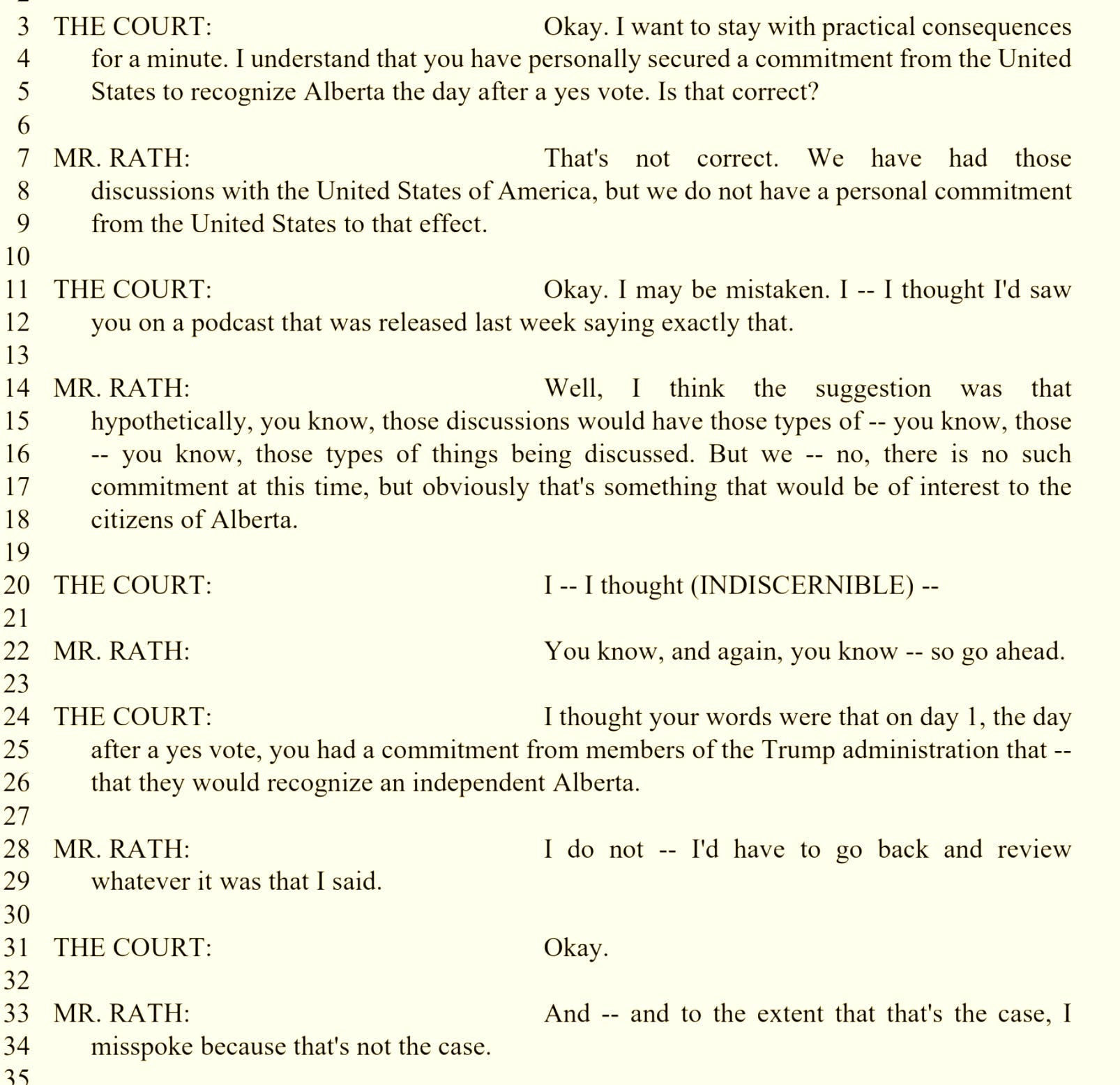
It is worth noting that the lawyer representing the APP in the hearing before Justice Feasby was none other than Jeff Rath their main spokesperson, (you know that big guy with the hat who looks like Boss Hog.) During the hearing Justice Feasby specifically asked Rath about statements he (Rath) had made regarding assurances that he (Rath) and the APP had secured in Washington from the Trump Administration about the United States recognizing Alberta as a sovereign entity immediately following a successful referendum.
Watching the hearing live, it sounded like Feasby had been doing his research on Rath and the APP and in one of the many YouTube videos posted by alt-media outlets about the movement, where Rath had uttered words to the effect that he had managed to gain such commitments from the Trump Administration. Rath, however, appeared to deny this during the hearing, saying “I misspoke”.
From the court transcript of 2503-15116 November 20, 2025 (available upon request):
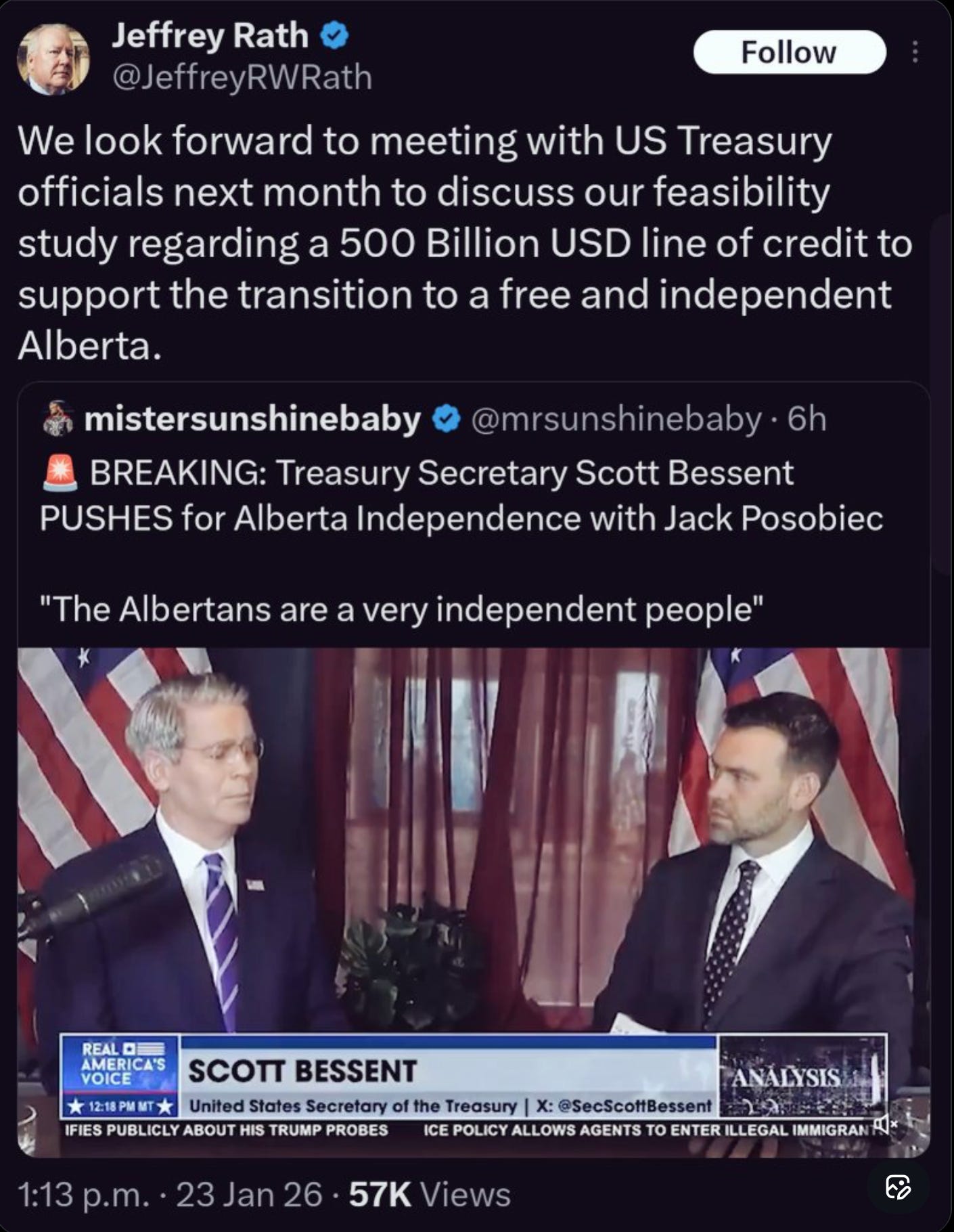
So with the Constitution and First Nations rights out of the way the UCP has further cleared the tracks for the separatists to foist their referendum on the country in a moment where the Trump Administration has put the world on battle stations. Reckless doesn’t begin to describe the legislative track record that brings us to this point now where the separatists— who have been to Washington three times and conspired with high levels of the Trump Administration to plot out what a post referendum relationship would look like with the US—are now licensed to collect signatures in support of a petition to bring about a sovereignty referendum. There is only one word to describe this: antidemocratic.
Separatist Smith?
Separatists are claiming that when they win they will instantly establish a free Alberta that is unencumbered by taxes and regulations and all the horrible things they blame the “Communists in Ottawa” for. But this fantasy is as bogus as the notion of a “sovereign Alberta within a united Canada.”
Alberta is a geographically large, resource rich province of some 5 million people. The US is numbering around 340 million at the moment. It is in possession of the most powerful military ever assembled in human history, run by a totalitarian regime, and has telegraphed a desire to dominate the hemisphere through a new form of resource imperialism described in its National Security Strategy.
So the idea that Alberta will somehow be free of US control is blind stupid and should enrage every thinking person who is forced to reason with it. The separatists can say what they want about independence after their secret meetings with senior Trump officials, and their deals to leverage Alberta’s oil reserves for a $500 Billion loan and pension roll overs, but 51st state this province will become as soon as those hooks are in.
And yet Alberta has been set on a runaway path towards a referendum on the question of whether it should leave Canada to become an independent state. This referendum, according to the Premier, is likely to happen this fall.4 She would know, because her government has done just about everything in its power to ensure this happens. Actions speak louder than words.
The Conservative Party Manifest 2015. See page 30. https://www.theresavilliers.co.uk/files/conservativemanifesto2015.pdf
Full transcript available here: https://globalnews.ca/news/11640013/alberta-judges-danielle-smith/
https://chatnewstoday.ca/2025/05/05/danielle-smith-albertans-post-2025-election/?utm_source=chatgpt.com
Patrick, Forever Canadian collected over 400,000 signatures on their petition. They did this under the previous rules regarding the number of signatures required, in the given time and with a court approved question. What happens to that petition? Why is it assumed that APPs question is the one that will be put to referendum if they collect their required signatures? It’s bad enough that she is ignoring 70% of the people in this province but also ignoring the Forever Canadian now legally certified petition. Can you shed light on how this would work.
Yesterday in Ottawa at the premiers-PM meeting, Smith shamelessly told staggering big lies.
She claimed that “30%”, “a million” Albertans, are sympathetic to separatism — according to polls, the number is around 10%, especially as people learn of the risks. She is blatantly overstating support.
She claimed that AB separatists “should not be demonized for their anger over ten years of Trudeau Liberals destroying AB.”
She did not explain why these separatists are angry that Trudeau and all Canadians literally bought TMX, or that oil production has steadily risen to all-time highs, or that AB is the richest per capita province.
I grew up in AB a long time ago. There have always been anti-Ottawa complainers - partisan Conservatives who hate federal Liberals. Now such people are turbo charged by MAGA, online conspiracy fuel, Covid restrictions, the convoy, etc. They are organized, funded (?), and they have captured the UCP government by controlling Smith’s leadership. They have tweeted threats to extort Smith (re huge healthcare corruption scandal involving the Premier’s top advisors).
Canadians need to understand that a small group of extremist, delusional, and Conservative partisans is holding Albertans hostage, and now the entire country. They have trampled many democratic norms already, as you outline clearly.
Smith’s entire public career has been to play with fire. She is deeply naive and shockingly weak as she persists in FAFO with Trump.
Few people in the rest of Canada understand any of this. People with public platforms like you must get the truth out there.
Thank you for your efforts!